CUSTOMER LOGIN

Where Remakes Really Come From in CNC Supported Joinery
Where Remakes Really Come From in CNC Supported Joinery
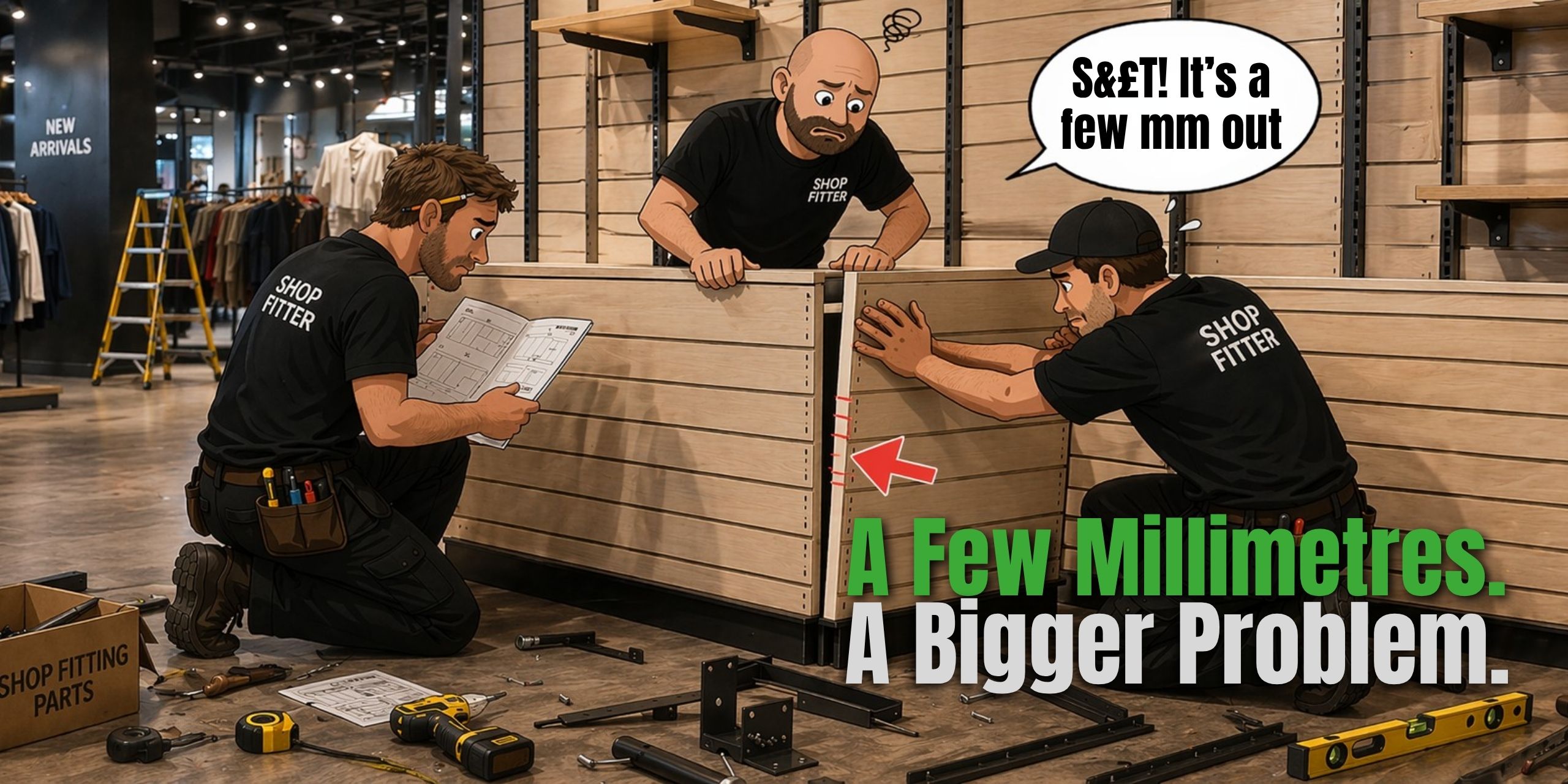
In joinery, the remake usually shows up late.
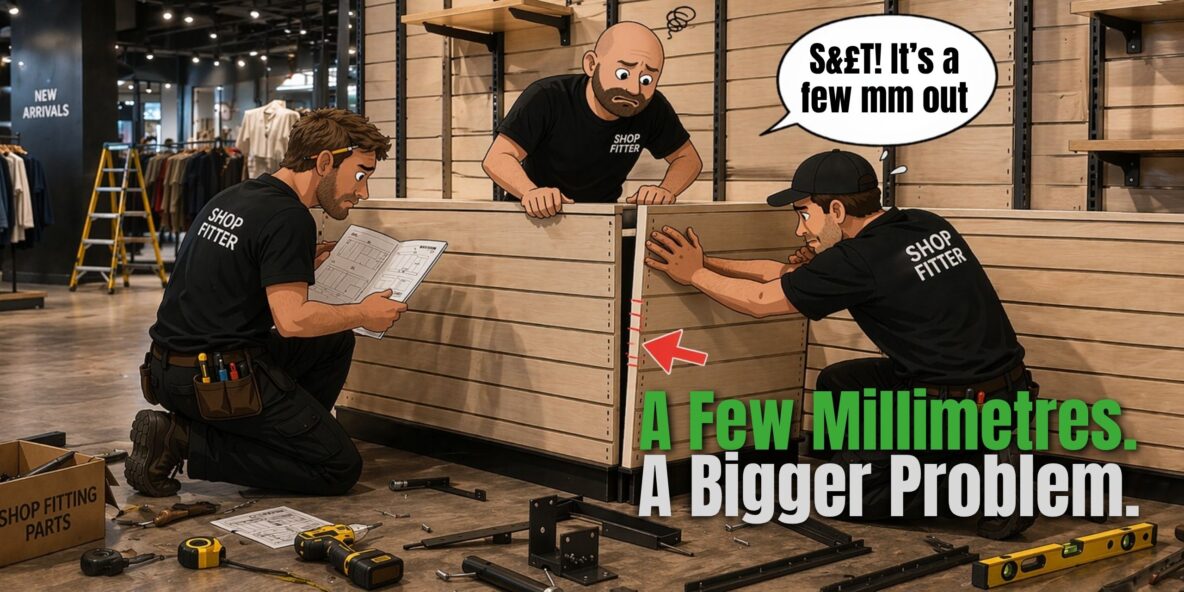
A cabinet does not fit cleanly. A panel arrives slightly out. A component that looked acceptable on the shop floor becomes a problem during assembly or installation. By that point, the visible failure is obvious.
What is less obvious is where it started.
In many CNC-supported joinery environments, remakes are not caused by one dramatic breakdown. They come from smaller problems introduced earlier in the process and carried forward until they become expensive enough to notice.
That is why remake reduction is not just an assembly issue or an installation issue. It is often a CNC process issue.
Remakes rarely begin where they are discovered
When a job has to be remade, the cost is not limited to the replacement part.
There is extra machining time, extra material, pressure on schedules, possible disruption to fitting dates and time lost by people further downstream. The later the issue is found, the more expensive it becomes.
This is what makes CNC-supported joinery so sensitive to small process failures. A part can be only slightly wrong and still create a much larger problem once it reaches edging, assembly or site installation.
That is why it is worth tracing remakes back to their point of origin rather than only reacting to where they surface.
Sheet movement is one of the most common hidden causes
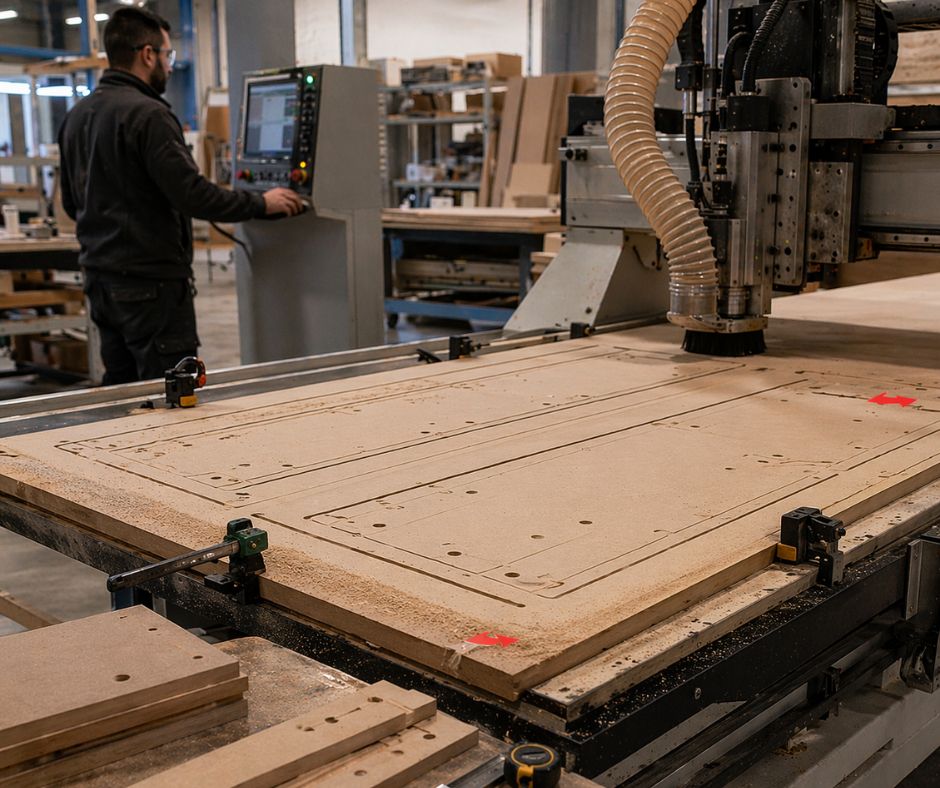
If the sheet is not being held securely, accuracy starts to drift before anyone talks about tolerances.
Movement does not always create a dramatic visible error in the moment. It can produce a component that is only slightly out, a hole pattern that feels just off, or a part that seems acceptable until it is paired with other pieces later in the process.
This is one reason remakes can be difficult to diagnose properly. The operator may not see an obvious failure at the machine. The problem reveals itself when fit, alignment or assembly quality starts to break down later.
Poor hold-down, uneven support or inconsistent loading discipline can all contribute. In bespoke joinery, where parts are often being produced for a specific fit rather than a generic stock dimension, that risk matters even more.
Tooling wear changes quality gradually, not all at once
Worn tooling is another frequent source of rework because it often degrades output slowly.
Edges become less clean. Dimensions drift. Surface finish changes. The process still appears to be running, but the quality margin narrows.
That gradual decline is dangerous because it encourages acceptance. People adapt around it. Slight corrections become normal. Extra sanding or hand finishing gets absorbed into the job. Eventually the variation becomes large enough to trigger a remake.
When businesses only replace tooling after visible failure, they are often reacting too late. In joinery, where fit and finish both matter, tool condition is not a minor maintenance detail. It is part of remake prevention.
File quality and sequencing errors also travel further than expected
Not every remake is caused by the machine itself.
Poorly checked files, incorrect offsets, missed updates and weak sequencing decisions can all create downstream problems. A part may be cut exactly as programmed and still be wrong for the job.
This is where CNC-supported joinery can become deceptive. Because the machine executes precisely, the output can look controlled even when the underlying instruction is flawed.
Sequencing matters as well. If parts are machined in a way that creates instability, increases the chance of movement or leaves critical features vulnerable late in the cycle, the process is creating avoidable risk. The issue may not be obvious until the finished part is handled, assembled or fitted.
Bespoke work increases the cost of small mistakes
In repeat manufacturing, a stable product line can sometimes absorb small errors more easily because the process is highly standardised and the learning loop is short.
Bespoke joinery is less forgiving.
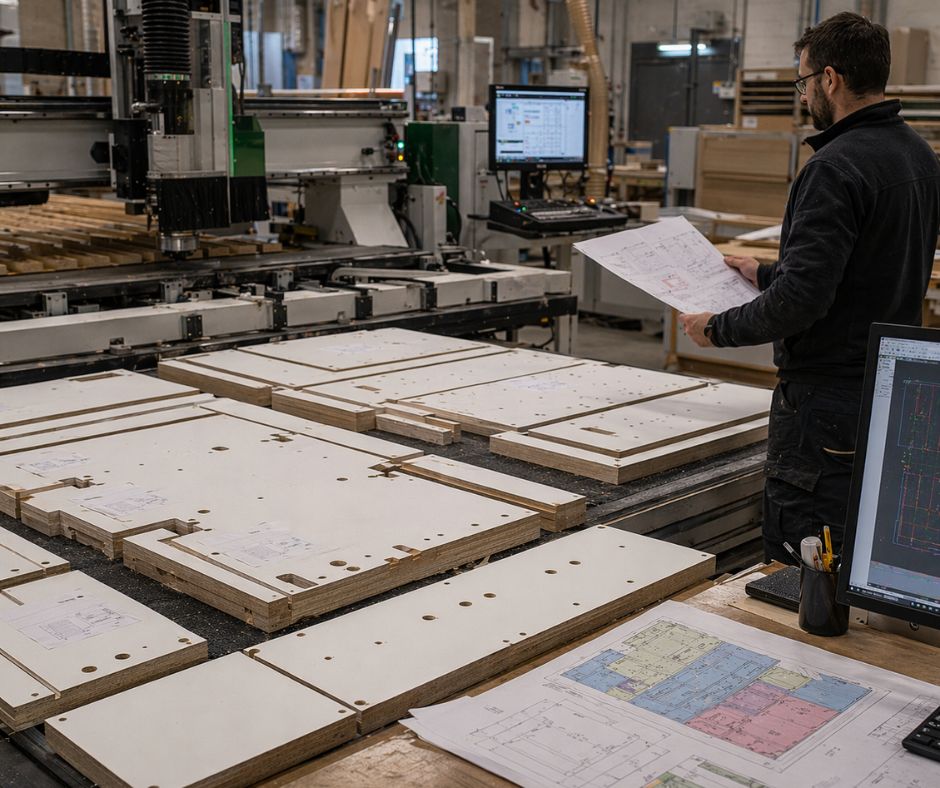
Each job may involve different sizes, different combinations of parts and different fitting conditions. That means a small process failure is less likely to be hidden by repetition. It is more likely to create a specific, costly problem for a specific project.
That is why bespoke work still depends heavily on repeatability. The parts may differ, but the standards for secure loading, tool condition, file control and machining discipline do not.
Reducing remakes means controlling the earlier stages better
If remakes are becoming too common, the answer is not only to inspect harder at the end.
The better response is to strengthen the earlier stages that create the finished part in the first place.
That includes:
- more reliable workholding
- closer attention to tooling condition
- tighter control of program and file changes
- better sequencing decisions
- clearer setup discipline at the machine
These are not glamorous improvements, but they are often the difference between a CNC process that supports joinery properly and one that quietly feeds avoidable cost into the business.
The aim is not perfection. It is fewer expensive surprises
No joinery business eliminates every error.
The real aim is to stop preventable issues being discovered when the cost of fixing them is already high.
That means treating the CNC stage as a critical part of quality control, not simply the cutting stage. When secure loading, tooling, programming and sequencing are controlled properly, the business is less likely to pay for the same job twice.
If remakes are becoming too common, it may be time to review whether your current CNC setup is giving the business the level of control and repeatability it now needs. Speak to our team.
Further Blog Posts
Aug / 2026
BS 559-2: Three practical questions for signmakers

Aug / 2026
Routing polycarbonate, HDPE and solid surface: why material versatility starts with the machine
Jul / 2026
How CNC cutting is reshaping retail interiors and displays

Jul / 2026
Why short-run structural packaging is becoming a CNC opportunity
Jun / 2026
The case for an ATC router in a metal fabrication shop
Jun / 2026
What makes the Tekcel EXR CNC Router different?
May / 2026
5 signs your CNC setup is making training harder
May / 2026
Where Remakes Really Come From in CNC Supported Joinery